
Could you tell us a little about yourself, your background, and what brought you to your current work and research?
I am a Roman historian by training, currently working in the School of Classics at the University of St Andrews. The study of Greco-Roman antiquity brings students and researchers into regular contact with war stories: they crop up everywhere, in ancient epic poems, tragic plays, monumental art and household objects. It is not an exaggeration to say that ancient life was saturated in war stories; and these tales of conflict and conquest continue to resonate in the modern world, as recently demonstrated by Christopher Nolan’s adaptation of Homer’s epic poem, The Odyssey.
I am interested not just in how ancient stories represent conflict (what they focus on, whose experiences they overlook, and how they narrate war’s aftermath) but also in what they do to us: how they shape assumptions and cement habits of thought - about how ‘inevitable’ or ‘impressive’ war is for instance, or what kinds of violence are acceptable. An important truth at the heart of my work is that stories are world building: the tales we tell and the pictures that we paint of conflict do not simply reflect the world we live in, they help to build it - by influencing how we think, feel and behave.
If this is true of war stories, it can also be true of peace stories. So as well as studying the dynamics of ancient and modern narratives of conflict, I study the kinds of stories that we do and don’t tell about peace and peacebuilding, and the various impacts which they can have. The more stories we tell about peace, the better we will understand, build and sustain it. In particular, we need stories that explore what peace means to different people in different contexts; and the various ways in which ordinary people can build and maintain peace from the ground up. It is only by developing our peace literacy that we can get better at forging peace in personal, local, national and international contexts.
I believe that peace history can help with this. In 2025 I founded the Ancient Peace Studies Network (https://apsn.wp.st-andrews.ac.uk/), an international community of researchers exploring how peace and peacebuilding were understood and experienced across antiquity. Our goal is to shed new light not just on peacebulding in the past but also on contemporary peace imaginaries and practices.
Together with my students, I have also curated a virtual Museum of Peace (https://peacemuseum.wp.st-andrews.ac.uk/) which brings together lots of different ways of visualising peace. Our aim is not to promote one particular vision. Instead, we want to spark more conversation about what peace ‘looks like’ to each of us, where different kinds of peace can be found, how it can be promoted, and what peace-making and peace-keeping actually involve. We think that talking about different manifestations of peace is an important step in empowering everyone to play a part in fostering it, no matter who they are.
What does peace mean to you, both personally and in your academic practice?
For me, peace means freedom - to live, work, socialise and dress as I choose, and to say what I think (so long as it does not hurt others). It also means freedom from worry - from financial stress, political uncertainty, the fear of oppression or discrimination or injustice. Academic freedom is obviously important to me; and I think that education - when it is freely available to all, and when it promotes critical thinking and responsible debate about contentious issues - is a vital foundation for building and sustaining personal, interpersonal and political peace.
You study and teach about war and conflict. What can studying war teach us about how to build peace?
It all depends how we study war! While very few bookshops have even a single shelf dedicated to ‘peace’, many contain large sections on ‘military history’. War studies is a vast field; there are thousands of books, articles and conferences about war (past, present and future) every year. This is understandable; wars are seismic events which bring about huge upheaval at local and global levels, and therefore they merit close analysis. However, too much of this analysis treats war as interesting or fascinating rather than as devastating and something we ought to be working to eradicate. Many studies have suggested, either implicitly or explicitly, that war is natural and inevitable; and some have a tendency to make it sound exciting, impressive, admirable, even desirable. Typically, those studies finish at the point where a conflict is resolved - stopping just as the slow, hard labour of peacebuilding is getting going. This kind of military (and militarising!) scholarship singularly fails to teach us much about peace!
However, there is a growing field of critical military studies, which interrogates the social, cultural and political drivers of armed conflict - including discourses of war that socialise us into accepting it as an inevitable part of human existence. Traditionally, war studies has tended to focus on ‘great men’ and ‘great events’; on strategy and tactics; on geopolitics and questions of nationhood, leadership and global order. When war studies focuses more on the human costs of war, and on local, everyday, personal experiences, it does a better job of bringing war’s consequences home to us, while paying more attention to the work that ordinary people do to mitigate war’s impacts. This kind of scholarship can complement peace studies, which not only looks at how conflict gets prevented and resolved but also at barriers to peace and peacebuilding in different contexts. Importantly, the war-peace binary is something we should challenge. People find and build pockets of peace amid conflict, and conflict (including violent conflict) can persist when peace has been declared. In other words, studying war ought always to involve studying peace, and vice versa, because the two phenomena are blur into each other.
How can we teach about war without making violence seem inevitable or normal?
One of the research projects which I direct is looking at exactly this question! (https://tawp.wp.st-andrews.ac.uk/) Young people frequently come across the topic of war in the classroom - and also in museum spaces, at tourist sites, in religious teaching, and many other contexts. Although we talk about peace as desirable, peace education is much less common than war teaching; a strange paradox! Unlike war teaching, peace education tends not to be incorporated into formal subjects, but delivered on the side as something ‘extra’ curricular. That imbalance needs to change.
It is easy to assume - thanks to the emphasis on war in so many education spaces - that the world is, and has always been, dominated by armed conflict. But the ancient city of Troy proves that assumption wrong. We associate it with war, thanks to a ten-year siege that has been the focus of blockbuster films as well as lots of ancient history lessons. However, the city was inhabited for around 3000 years, and for much of that history Troy enjoyed peaceful relations with its neighbours while its inhabitants farmed their land, crafted all sorts of things, worried about the weather, socialised with each other, and got on with all the routines of a relatively settled life. Our teaching ought to pay more attention to that kind of history, to correct the misconception we have that humans have always simply lurched from one armed conflict to the next.
Equally important in is the need to connect on a human and emotional level with the people whose conflicts we are studying. There can be a tendency when teaching about past conflicts in particular to refer to catastrophic events or casualties in detached terms, almost as if we are not talking about real human beings. By contrast, when we make a conscious effort to identify individuals, use their names, picture their lives, and consider the many people in the wider community to whom they mattered, it is difficult not to be upset by what has happened to them as a result of war. This kind of teaching requires care; the aim, of course, is not to distress students but to resist habits of discussing war that leave us desensitised to or accepting of it. Arguably, if we are not concerned or upset while tackling the topic of war in the classroom, we are probably not teaching it well.
What role do literature, storytelling, and individual experiences play in helping us understand the human cost of war and imagine peace?
Stories can take us to places we have never been, get us walking in other people’s shoes and help us visualise alternative futures. They can drive home the huge variety of war’s impacts on people in many different contexts; and they can also be creative spaces in which we test out hypotheses and explore new possibilities.
I have run research projects on ‘visualising’ war and peace (https://arts.st-andrews.ac.uk/visualising-war/ and https://vpp.wp.st-andrews.ac.uk) because I am interested in how dynamic stories - or visualisations - are. When we ‘visualise’ something in a story or a work of art, we might picture or imagine it in ways that can conjure it into being, helping us to make concrete what we have envisioned. To illustrate this, I want to share a poem called ‘A Boy Builds A Cheetah', which was submitted by Tom Nalder when he was aged 9-11 to an annual competition run by the charity Never Such Innocence (https://www.neversuchinnocence.com).
The boy was tired of conflict
so he built a cheetah.
To yellow fur he added dots,
so he could take shelter
and know warmth.
He added strong eyes,
so he could see danger.
He pasted on round, circular ears,
so he could hear the cheetah’s warnings.
He filled four legs with energy,
so he could escape with speed.
He striped half the tail,
so he could hold the rudder in tough times
He built permanent claws
on paddy paws,
to help protect himself.
The boy rode the cheetah
into warzones, and stole
bombs, guns and despair.
The boy rode the cheetah
into borders, and let people
live where they needed to.
The boy rode the cheetah
to unhappy places, and left
baskets of peace and joy.
The cheetah ran so fast he flew,
and if you look carefully at the sky,
you will see a striped tail
and the sandals of a boy.
In ‘A Boy Builds A Cheetah’, Tom Nalder conjures an imaginary child, ‘tired of conflict’, who dreams up a magical cheetah to ride into warzones and steal ‘bombs, guns and despair’. Of course, this super-human cheetah and the boy(s) who created him operate in the realm of fantasy, not reality, harnessing powers which ordinary people are not thought to possess. They fly high in the process, becoming a symbol of hope that others can look up to; but they are pushing at theboundaries of possibility, going out of this world, almost beyond sight.
And yet that is the point: a child’s imagination (the author reveals) can take us to places we might not otherwise go. It can conjure shelter and warmth in the wake of violence; it can displace unhappiness with visions of peace and joy. While the super-powered cheetah might out-run us, we can follow in both boy and author’s footsteps by visualising an alternative to militarism – and, crucially, by not infantilising that alternative vision as ‘child’s play’. The author ends the poem by encouraging us to look skywards; not to lose sight of the striped tail that can steer us through tough times or the sandals of the boy who dreamt that tail/tale up. The cheetah is a product of war but also a metaphor for a different, more creative, visionary way of addressing conflict. The boy’s placement in the final stanza, nearly out of sight, reminds us how frequently unseen and unfollowed such blue-sky thinking can be.
As speculative fiction pioneer Ursula le Guin argued, writing like this is not an escape into the imaginary; it is the antithesis of escapism because it is a way of reckoning with reality in more engaged and tangible ways that can broaden our understanding of it. Crucially, speculative fiction (Le Guin believed) rejects the straight-jacketed, seemingly indisputable ways of knowing the world that historical ‘facts’ can impose on us; it frees us from the opposition between possible and impossible, real and fantasy; and in so doing, it shows us other ways of world-making.
What role can museums play in helping people move from remembering and understanding conflict towards actively imagining and practising peace?
Museums receive millions of visitors each day. Many of them centre war, quite literally; in the British Museum in London, for instance, the room on Roman Britain is dominated by displays at the centre of the room full of military weapons and armour. Everyday life and ordinary people’s efforts to find and maintain peace and security are pushed to the margins or missing. This can change not only by centering different objects but also by telling different stories about those objects. For instance, an ancient coin showing a Roman emperor celebrating a military triumph - usually used to shed light on their power and campaigns - could become a prompt to imagine the lives of people who handled that coin as they bought and sold things, paid an employee, visited relatives, went travelling, and so on. Importantly, we need this kind of museum curation to happen repeatedly, not just as a one-off, token ‘everyday life’ vignette in a space still dominated by people of power and privilege.
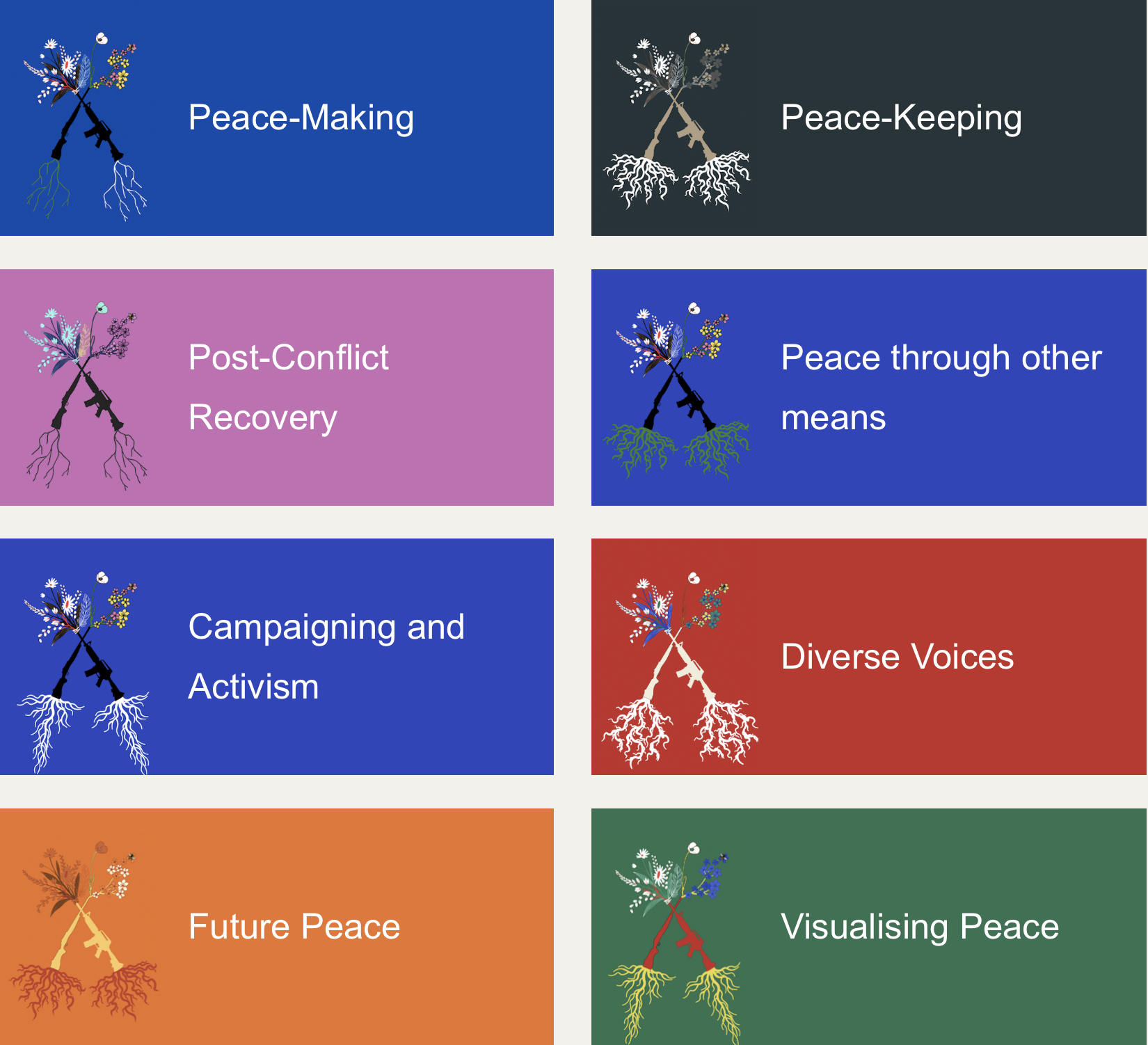
In an effort to increase the amount of museum space that actively explores peace and peacebuilding, my Visualising Peace students and I have created a virtual Museum of Peace (https://peacemuseum.wp.st-andrews.ac.uk). Each contributor museum has added visualisations of peace based on their own areas of expertise and interest – from top-down to grassroots peace-building, utopian to dystopian ideas, belligerent to pacifist models, geopolitical topersonal conceptions, aftermath to futures thinking. Our goal is not to promote certain visions of peace ahead of others, but rather to amplify the many different understandings and approaches that humans have experimented with over the years, from antiquity to today, as a valuable archive or repository of the many pathways to peace that we can continue to explore in the future, depending on individual circumstances. If we have learnt anything from our curation of different concepts of peace, it is that it can be understood and achieved in an extraordinary range of ways – and we want to celebrate that, because it is an empowering message. Above all, we want to spark more conversation about what peace looks like to each of us, how it gets imagined and represented, where different kinds of peace can be found, how it can be threatened as well as promoted, and what peacemaking and peacebuilding involve at all levels - personal, local, national, global. We think that talking about different manifestations of peace is an important step in fostering it, not just in high office but in our lives day-to-day.
If peace is something we need to practice, rather than simply hope for, what is one thing each of us can do to make peace more present in our society?
Talk about peace and peacebuilding more! Ask other people what it feels like to them; share stories that centre peace and peacebuilding; experiment with picturing peace on instagram. Who knows, if we talk about it enough, we might get to the point where governments appoint a minister for peace or have a peace budget. We might stop imagining peace as some distant fantasy but recognise and resource the work that we have to do now, every day, to build and sustain it in the present.
Prof. Alice König
University of St Andrews
